INTRODUCTION
JFK Terminal 4 approached Ronik to redesign its digital experience. As the agency’s co-founder and Managing Director, I led the effort to transform how over 21 million annual travelers obtain vital information at the largest and only privately-owned terminal at New York’s JFK airport. The project encompassed three key channels—website, main arrivals boards, and in-terminal kiosks—and was anchored in the terminal’s mission to “Guide & Delight.” The challenge, as expressed by their team during initial discussions, was that “once some enters an airport, their reasoning skills go out the window.” This memorable observation would come to inform our entire approach.
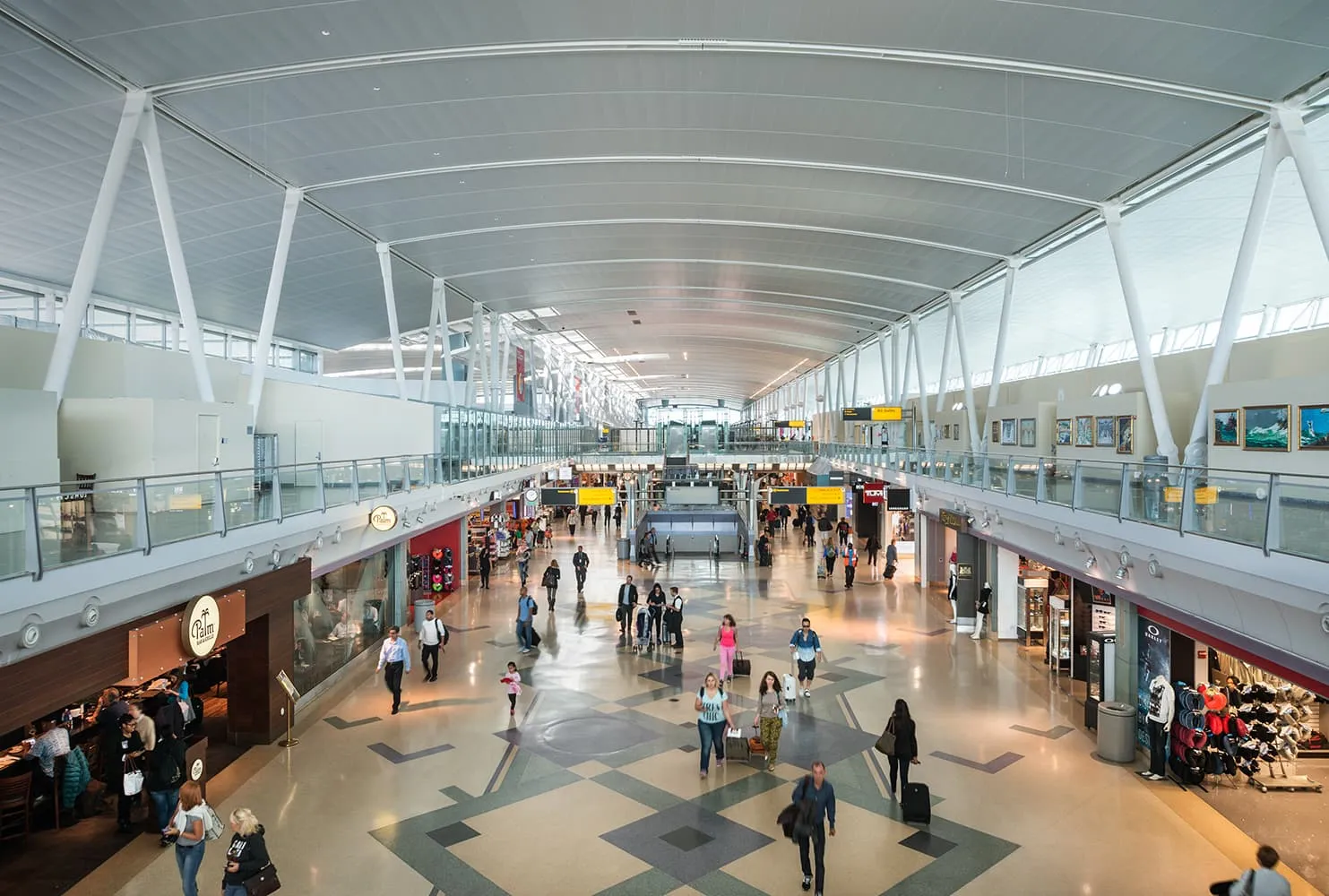
Environmental photography of the terminal
As project lead, I led the effort to reimagine how over 21 million annual passengers interact with the terminal through three key channels: website, in-terminal kiosks, and the main arrivals board.
Our team tackled T4’s unique position as the only privately owned terminal in New York’s JFK Airport. After their fresh, modern rebranding, we took on the challenge to envision a new digital experience that serves their diverse audience groups while embodying their mission to “Guide & Delight.”
DISCOVERY & STRATEGY
The physical reality of Terminal 4, including the sheer scale of its mile-long layout, required careful consideration. It came to shape every aspect of our digital strategy.
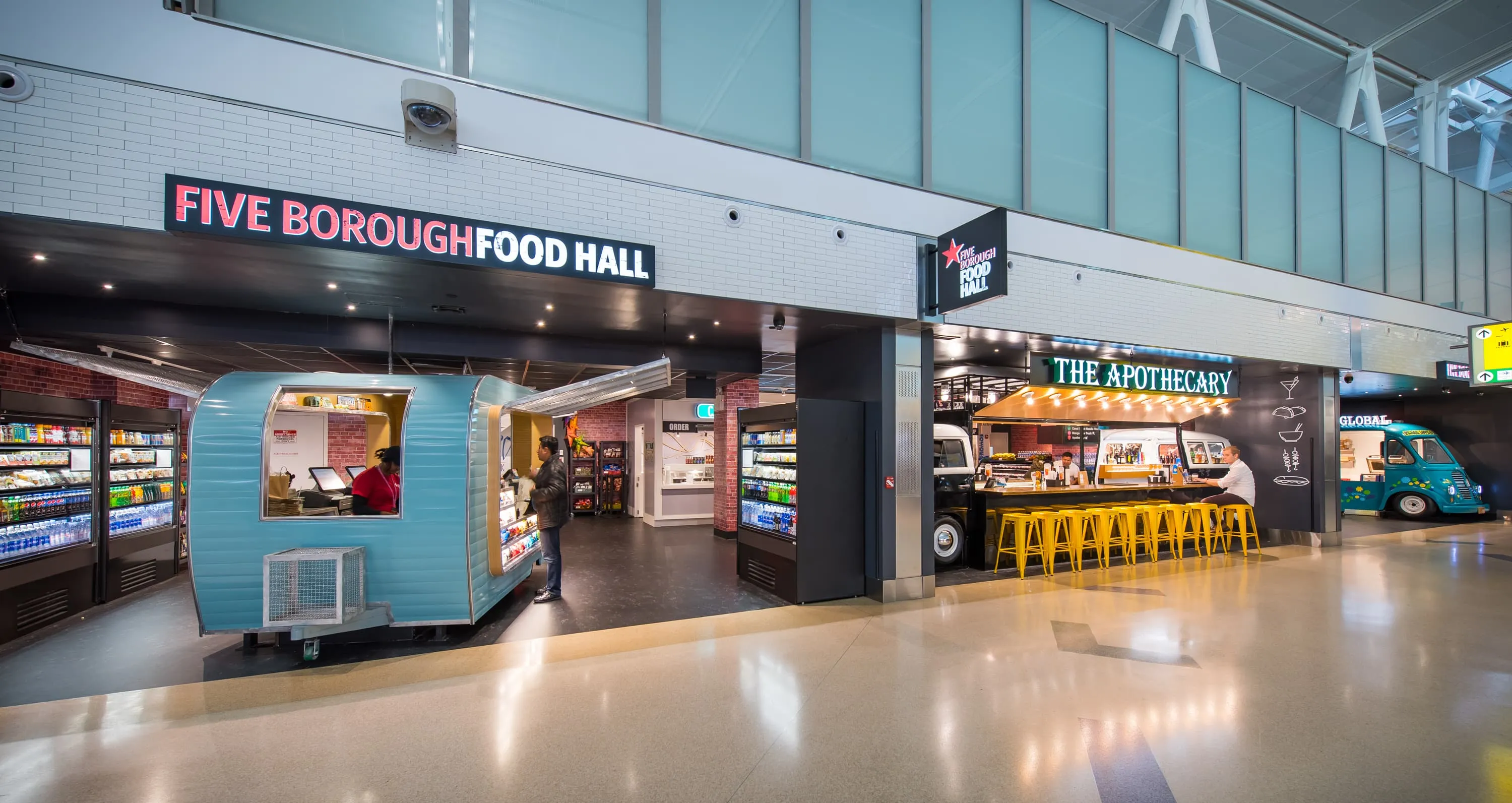
Five Borough Food Hall, JFKT4
Research Approach
We implemented a comprehensive discovery process focused on understanding both the physical and digital challenges of the terminal environment. Our research included:
- 100+ passenger intercept interviews and surveys
- Stakeholder interviews with terminal operations, airlines, and retail tenants
- Multiple site visits during peak and off-peak hours
- Analysis of existing digital infrastructure and security protocols
- Review of passenger flow data and common pain points

A wall displays our organized user research notes.
The Research & Discovery process revealed insights into the needs of both travelers and terminal staff.
Key Findings
Physical Context:
- Terminal’s mile-long layout created distinct zones with different user needs
- Security checkpoints created natural bottlenecks affecting passenger behavior
User Segments & Needs:
- Departing Passengers
- Primary concern: Time management through security and to gate
- Need: Real-time wait times and gate information
- Context: High stress, limited attention span
- Arriving Passengers
- Primary concern: Ground transportation and exit routing
- Need: Clear wayfinding and transportation options
- Context: Fatigue, unfamiliar environment
- Meeters/Greeters
- Primary concern: Accurate arrival timing
- Need: Real-time flight status updates
- Context: Extended waiting periods, need for amenity information
- Terminal Staff
- Primary concern: General communications
- Need: A content management system for rapid updates
- Context: Various technical skill levels
Technical Constraints
The terminal’s existing technology infrastructure provided both opportunities and constraints. Security sensors offered real-time data on wait times via API, but strict security protocols required on-premise hosting behind firewalls. We thus needed to rethink our typical cloud-based approach.
- Security requirements mandated on-premise hosting
- Custom API integration for legacy systems
- Fault-tolerant handling for real-time data
- Multiple display technologies with different capabilities
Pulling It All Together
These insights guided every aspect of our work, from UX and design through copywriting, content creation, and development. We learned that an effective solution needed to serve multiple critical functions:
- For customers: Provide clear guidance while reflecting the terminal’s warm, helpful personality and vibrant visual branding
- For staff: Deliver a flexible tool that staff can rapidly update for changing messaging needs
- For operations: Create an interconnected ecosystem that would serve as both marketing and customer service backbone
Multi-Channel Implementation
Our solution architecture addressed three distinct contexts:

Design Brief document created after the project's research phase. Used as a design bible for the remainder of the project.
Web Platform
Strategy:
- Mobile-first design approach
- Progressive enhancement for feature phones
- Offline capabilities for limited connectivity
- Multi-language support framework
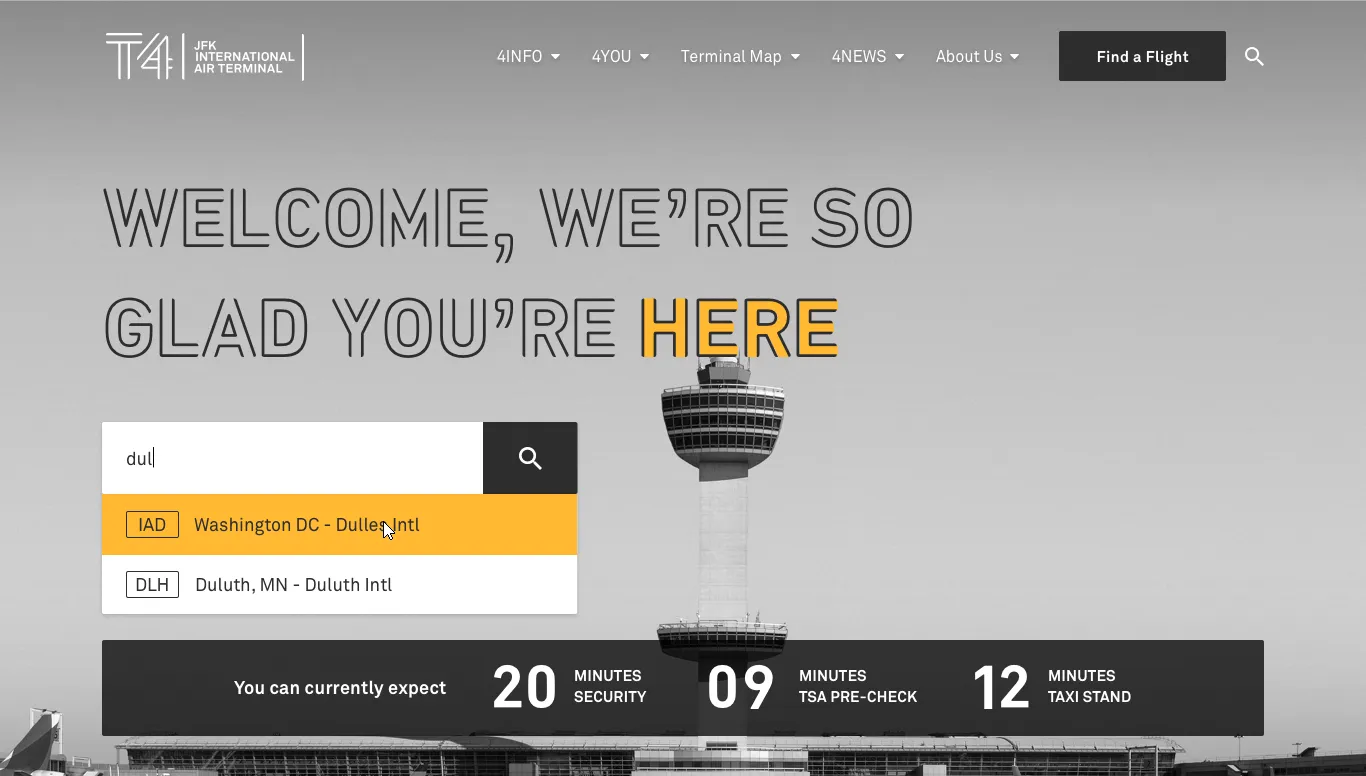
jfkt4.nyc homepage hero visual design
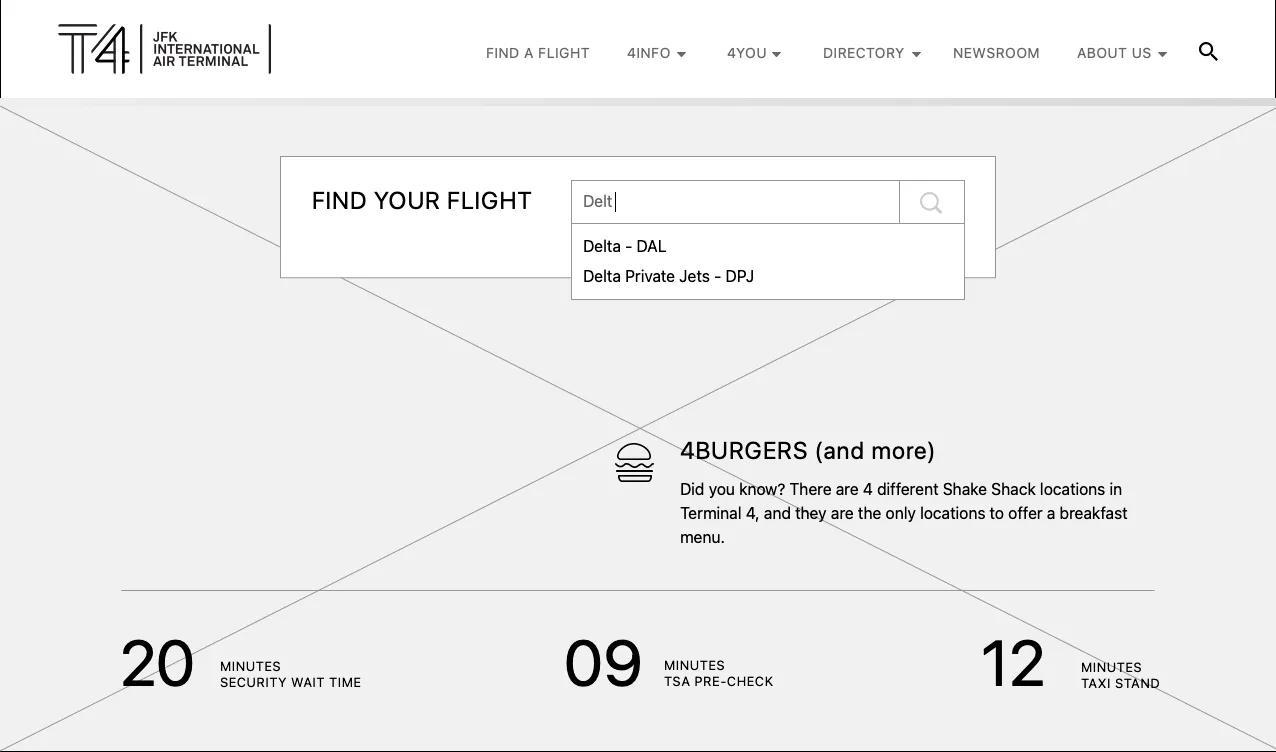
jfkt4.nyc homepage hero wireframe
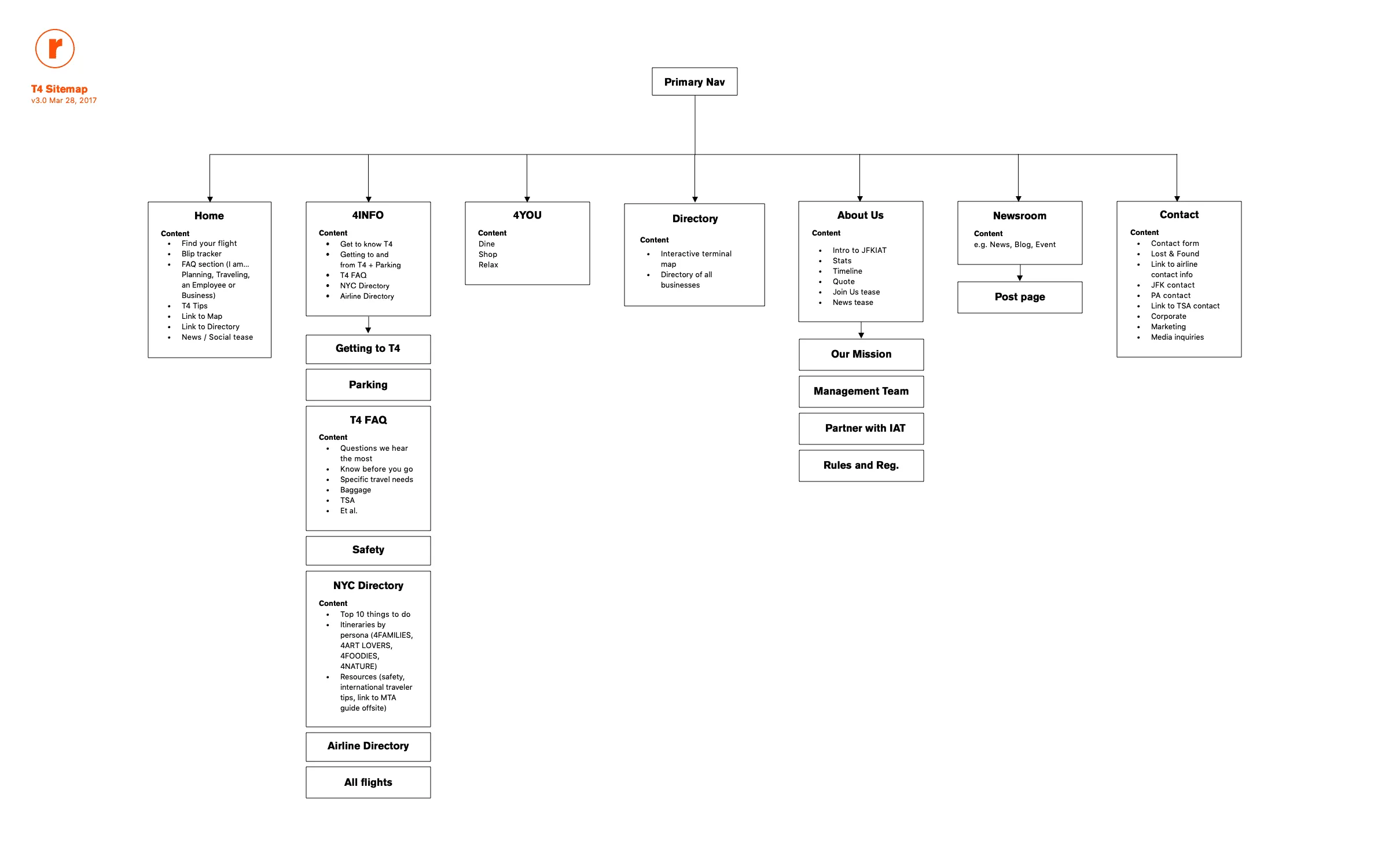
jfkt4.nyc sitemap
Results:
- 25% reduction in customer service calls about basic terminal information
- 3x increase in mobile engagement
- Successful handling of peak traffic during holiday seasons
In-Terminal Kiosks
We designed and developed touch-screen directory kiosks throughout the terminal, ensuring consistency by using the website’s design language and technology. Our team carefully adapted the content and user experience to meet the needs of en-route travelers seeking quick information.

Visual documentation showing the progression from foundation to components
Strategy:
- Location-aware content prioritization
- Simplified touch interfaces for stress contexts
- Real-time synchronization with central systems
- Fault-tolerant offline operation
Implementation:
- Custom touch-optimized interface
- Cached data architecture
- Hardware-specific optimizations
Environmental photography showcasing the terminal's physical context and scale
Arrivals Hall Flight Information Display
The redesign of the main flight information board in the Arrivals hall served as a centerpiece of our multichannel strategy. This massive digital display functions as a critical information hub for thousands of people awaiting arriving passengers. We reimagined this experience, creating a clear visual hierarchy that made flight statuses instantly scannable while maintaining the terminal’s brand identity. The design prioritized legibility at significant distances while accommodating complex data requirements for international flight tracking, multiple airlines, and real-time updates. Through carefully chosen typography and thoughtful use of color and contrast, we transformed a purely functional element into one that balanced utility with the terminal’s “Guide & Delight” mission.

Environmental photography showcasing the terminal's video wall
Strategy:
Modular display system supporting multiple layouts:
- Standard flight information displays
- Weather updates and alerts
- Terminal messaging and announcements
- Custom layout configurations for different operational needs
- Real-time data integration from multiple airlines
- Emergency override capabilities
Animated video wall
Implementation:
- Custom layout engine for complex flight data
- Fault-tolerant data handling
- Remote management system
Results:
- Creation of an engaging, informative display that embodies JFKT4’s “Guide & Delight” ethos

Environmental photography showcasing the terminal's video arrivals board
Design System Development
Our cross-functional team of designers, developers, and content strategists created a comprehensive design system that would scale across all terminal touchpoints. This required balancing stakeholder needs, technical constraints, and operational realities while maintaining team velocity.
Strategic Leadership
Team Structure & Development:
- Led 8-person core team (4 designers, 4 developers)
- Established early engineering involvement for feasibility validation
- Created documentation standards for sustainable knowledge transfer
Stakeholder Management:
- Conducted bi-weekly executive reviews with terminal leadership
- Coordinated with terminal technical teams for data integration
- Managed relationships with third-party vendors
- Facilitated workshops between client and design teams
Brand Integration & Typography
Early in the project, we identified a critical gap: the custom typefaces from the terminal’s recent rebranding weren’t web-ready. Rather than compromise the brand or create operational inefficiencies, we made a strategic case for developing a complete typeface system.
The decision centered on operational efficiency: without web-ready fonts, every heading change would require an Adobe Illustrator specialist. By demonstrating the impact on content updates, we secured buy-in for the investment. This decision improved consistency across both digital channels and terminal marketing materials.
Component Architecture
Our design system adapted across channels while maintaining consistency. The iconography system became a recognizable element, featuring playful, illustrative styles that brought personality to the terminal experience. Example: a smiling plane flying over clouds as a loading animation on the flight information screen.
Technical Implementation
As the head of technical initiatives at Ronik, I first conducted in-depth interviews with key technology stakeholders at JFK T4. These established the project’s technical requirements and ensured alignment with business needs. Next, I organized a series of collaborative architecture planning sessions with JFKT4’s IT team. Together, we crafted a development road map that addressed the unique challenges of terminal operations.
Real-Time Data Integration
The system we developed integrated two critical real-time data streams:
- Vendor-provided API supplying wait time information from sensors throughout the terminal
- Internal API maintained by terminal flight operations
We optimized the data display for each individual channel:
- Website: Prominent wait times for arrival planning
- Arrivals board: Focus on arrival information with optional taxi wait times
- Kiosks: Default to departure information for airside passengers
Project Management
Team Structure & Communication
To build a strong foundation for our team’s success, I developed a comprehensive leadership framework that brought clarity and purpose to our operations. Understanding that clear expectations are crucial, I carefully mapped out roles and responsibilities, ensuring every team member understood their unique contributions to our shared goals.
Setting Clear Expectations
- Implemented structured code review process
- Established clear documentation standards for improved efficiency
- Mapped out detailed roles and responsibilities
Communication & Meeting Rhythm
Internal
- Daily engineering standups for team alignment
- Weekly progress reviews for proactive challenge resolution
- In-depth weekly design reviews for technical collaboration
- Focus on mentoring junior developers through complex challenges
Client
- Bi-weekly stakeholder sessions
- Regular progress showcases
- Continuous feedback gathering
- Maintained alignment with evolving client needs
Beyond strategic work, I took an active role in nurturing team growth and excellence. I found particular fulfillment in mentoring junior developers, helping them navigate complex integration challenges while building their confidence and capabilities.
Future Direction
Terminal 4 is exploring AI-powered chat assistance across channels. Our systematic approach created a strong foundation for this evolution:
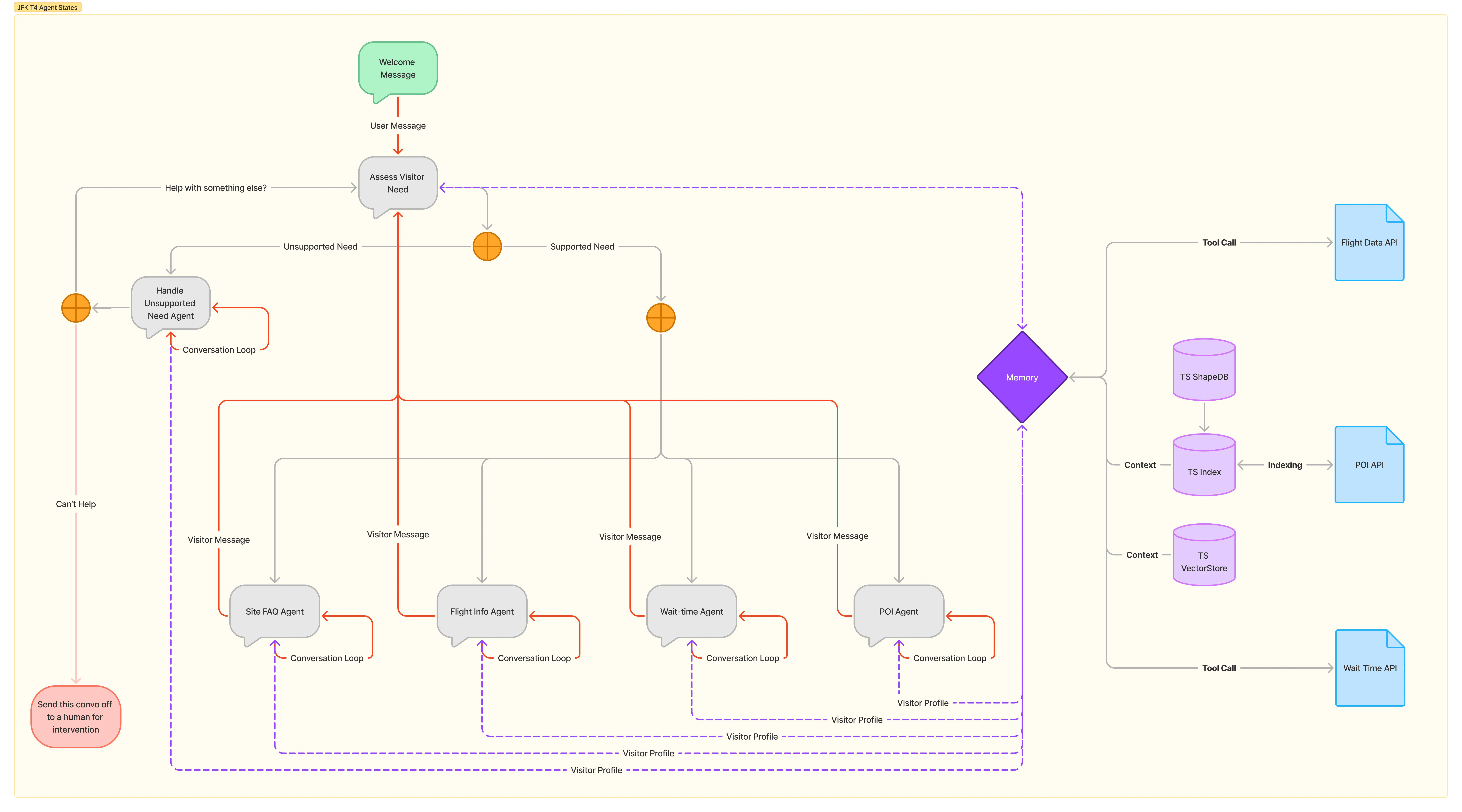
Diagram of AI Agent architecture for JFK Terminal 4
- Unified web platform for consistent deployment
- Location-aware kiosks for contextual assistance
- Structured content management
- Established security protocols
The validation process will follow our proven methodology:
- Expert evaluation
- Internal testing
- Limited deployment with observation
- Iteration
- Full rollout with continuous monitoring
Key Learnings
This project reinforced crucial lessons about designing for complex environments:
- Systematic design approaches enable future innovation
- Strategic technology choices simplify operations
- Real-world validation remains essential
- Clear stakeholder communication drives success
The bigger lesson: in complex operational environments, good interfaces aren’t enough. The work also requires understanding how operations actually run, managing stakeholders carefully, and thinking systemically.
RECOGNITION
In 2018, Terminal 4’s website received recognition as a Webby Award Honoree for its innovative approach to serving the public sector, specifically in the “Government & Civil Innovation” category.
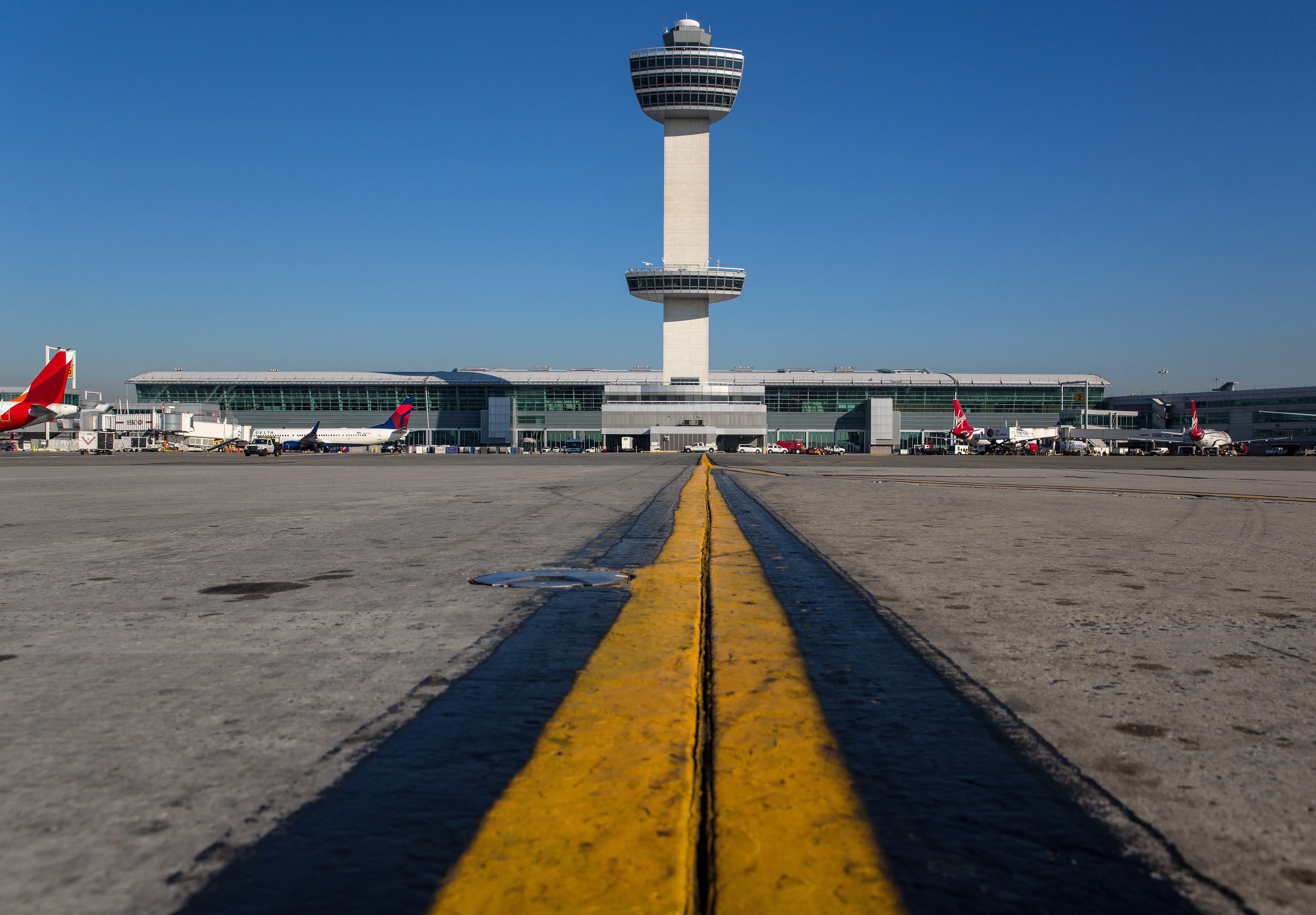
Terminal exterior, with tarmac